A gym can have good equipment and still feel wrong.
That usually happens when the space has not been zoned properly.
Zoning is one of the most important parts of planning a training facility because it affects how people move, how coaches work, how safe the environment feels, and how professional the facility appears once it is live. A strong gym layout does more than make the space look organised. It makes the facility easier to use, easier to manage, and far more effective as a working training environment.
If you are opening, upgrading, or expanding a gym in South Africa, zoning should be treated as a core planning decision, not something left until the end. Done properly, it improves flow, protects safety, and creates a much better member experience from the moment people walk in.
What Gym Zoning Actually Means
Zoning is the process of dividing the facility into logical training areas based on how the space needs to function.
Instead of thinking of the gym as one open floor full of equipment, zoning helps you think in terms of:
- what activities happen where
- how those activities relate to one another
- how members move through the space
- where congestion could happen
- what needs separation
- what needs visibility
- what needs easier access
This is one of the reasons zoning sits naturally inside the Iron Grid content strategy under infrastructure and fit-out decisions. The goal is not just to talk about products, but to help commercial buyers think through layout, planning, and the real-world performance of the space.
Why Zoning Matters So Much
A gym layout affects the day-to-day reality of the facility more than many owners expect.
Good zoning improves:
- movement flow
- training efficiency
- coaching visibility
- safety between active areas
- equipment usability
- cleanliness and organisation
- how members experience the space
Poor zoning often leads to:
- awkward traffic patterns
- overcrowded areas
- underused equipment
- weak separation between training styles
- safety issues around busy zones
- a gym that feels confusing or unfinished
That is why zoning should be thought about early, ideally before the equipment list is fully locked in.
Start With the Type of Gym You Are Building
Not every gym should be zoned the same way.
A fight gym, a commercial gym, a functional training facility, a strength and conditioning space, and a boutique studio all have different spatial needs. Even hybrid gyms need a clear internal logic.
For example:
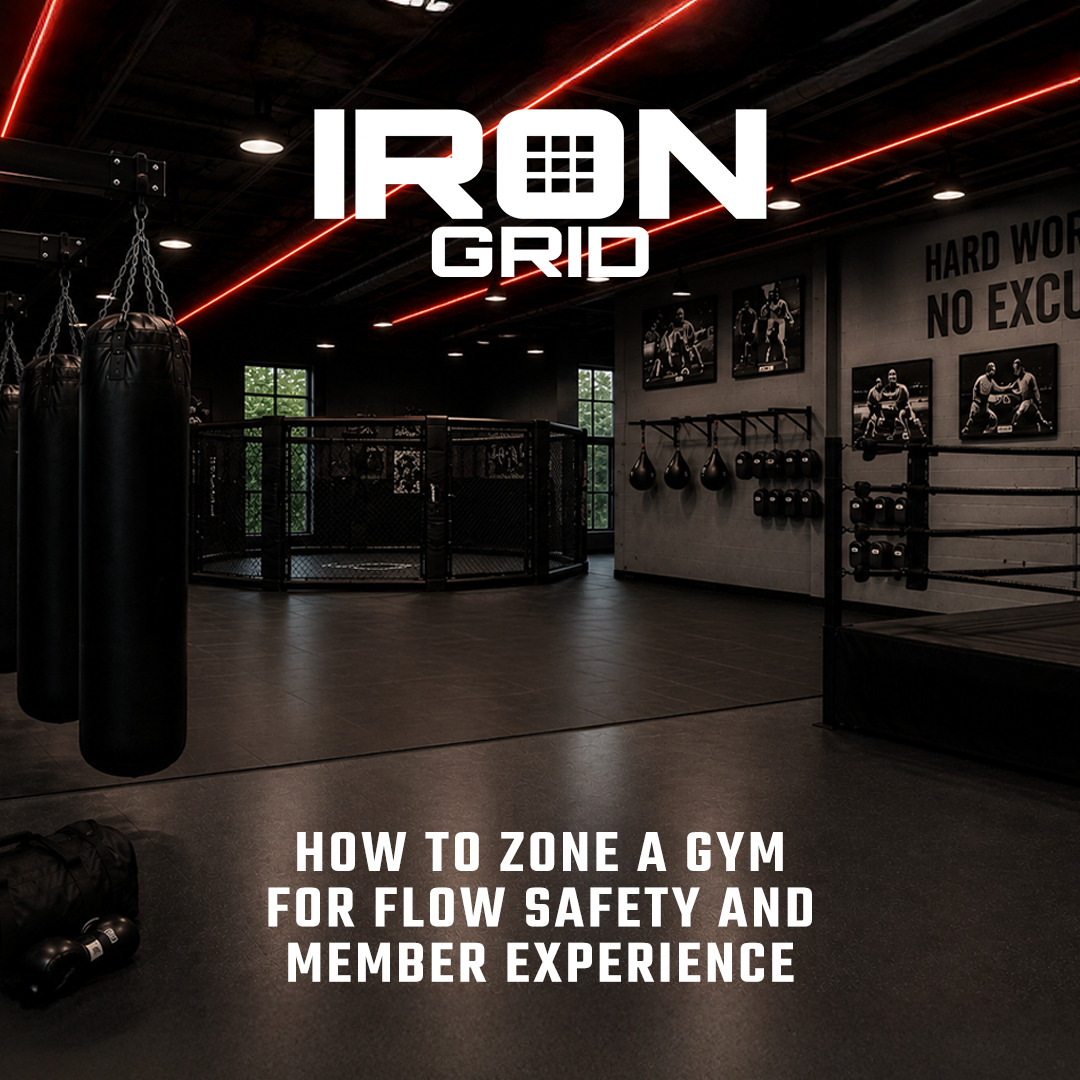
- a fight gym may need bag work, sparring, mat space, conditioning, and reception or retail areas
- a commercial gym may need cardio, strength, free weights, stretching, and functional space
- a functional training facility may need open movement lanes, rigs, conditioning zones, and storage
- a studio may need a calmer, cleaner flow with more deliberate spacing and fewer visual interruptions
This is consistent with the broader Iron Grid approach that customer-facing thinking should be organised by facility outcomes, not just by product categories.
Think About How People Move Through the Space
One of the easiest ways to improve a gym layout is to think about the path a member actually takes through the facility.
Ask:
- what do they see first when they enter?
- where do they go next?
- where do they warm up?
- where do they train most heavily?
- where are the highest-traffic points?
- where could bottlenecks happen?
- how do they move between zones?
A good layout feels intuitive. People should not have to guess where things belong. The space should naturally guide movement from one area to the next.
That is what people often mean when they say a gym has “good flow.” It feels clear, usable, and deliberate.
Separate High-Impact Areas Properly
One of the most important zoning principles is making sure incompatible activities do not interfere with one another.
For example:
- heavy free-weight areas should not choke main walkways
- conditioning tools should not spill into circulation zones
- bag work should have enough room around it
- grappling or mat zones should not be exposed to unnecessary traffic
- stretching and mobility spaces should not be wedged into chaotic corners
The goal is not rigid separation for its own sake. The goal is to reduce friction between different types of movement and create a safer, more usable environment.
Plan Around Core Training Zones
A strong way to zone a gym is to identify the facility’s core functional areas first.
Depending on the project, those may include:
- reception or arrival
- cardio
- strength
- free weights
- functional training
- stretching and mobility
- bag work
- sparring
- grappling or mat zones
- studio areas
- storage
- support or staff areas
This is exactly the kind of thinking Iron Grid has already been building into the blog and fit-out strategy: helping buyers think in zones, layout, equipment mix, and infrastructure, rather than isolated product decisions.
Once the zones are clear, it becomes much easier to decide:
- how much space each one needs
- which ones should sit close together
- which ones need more separation
- how flooring should be handled
- where storage should live
- how the equipment mix should be distributed
Safety Should Be Built Into the Layout
Safety in a gym is not only about equipment quality. It is also about spatial logic.
A poorly zoned gym can create risks simply because people are forced to move through the wrong places or train too close to incompatible activities.
Good zoning helps protect safety by:
- preserving clear walkways
- reducing congestion
- creating enough space around high-movement zones
- separating impact-heavy areas where needed
- keeping coaching sightlines open
- making emergency movement through the facility easier
A gym that is hard to move through is often a gym that becomes harder to manage safely.
Member Experience Depends on More Than Equipment
A lot of owners assume member experience is mostly about good-looking equipment and branding.
That matters, but layout plays a huge role too.
A well-zoned gym tends to feel:
- easier to understand
- more comfortable to move through
- less chaotic
- more premium
- more professionally run
This is especially important if the facility needs to appeal to a broader audience beyond hardcore regulars. Even performance-driven spaces benefit from being clean, logical, and easy to navigate.
The member may not describe it as “zoning,” but they absolutely feel the difference.
Coaching Visibility Matters
A gym is not only used by members. It is also used by coaches, staff, and operators.
That means zoning should also consider:
- where coaches need clear sightlines
- how classes are managed
- where supervision matters most
- which zones need more open visibility
- where congestion makes coaching harder
A facility that looks fine on paper can become frustrating in practice if coaches cannot see key areas or move easily between them.
This is one of the reasons layout planning is such a strong authority-building topic for Iron Grid. It helps position the brand as a serious fit-out partner rather than a simple supplier.
Storage Should Be Part of the Zone Plan
Storage is often forgotten when people think about zoning, but it should be part of the layout from the beginning.
Without good storage placement, even a well-planned gym can start to feel messy and congested.
Storage should be positioned so that:
- it is easy to access
- it does not block movement
- it supports the zone it belongs to
- it helps keep the floor clean and usable
For example, kettlebells, plates, and accessories should live close to the zones that actually use them. Storage should support flow, not fight against it.
Flooring and Zoning Should Work Together
Flooring choices should reinforce the zoning strategy.
Different zones often need different surfaces, and the layout should reflect that. For example:
- free-weight areas may need more durable rubber surfaces
- grappling or technical combat zones may need matting
- studio spaces may require cleaner, more refined finishes
- high-traffic movement areas may need especially hard-wearing surfaces
This is why zoning and flooring should not be treated as separate conversations. They are both part of the same fit-out logic.
Common Zoning Mistakes
A few mistakes show up repeatedly in new gym projects.
Treating the gym as one open floor
Without clear zoning, the facility often feels messy and hard to use.
Overcrowding one area
This usually happens when too much equipment is pushed into a zone without enough room for actual movement.
Ignoring traffic patterns
Main walkways and transitions often get blocked when zoning is done too late.
Forgetting storage
A gym with no logical storage plan almost always feels weaker in use.
Mixing incompatible training types too closely
This can create both safety issues and poor member experience.
How to Approach Zoning Properly
A strong zoning process usually starts with a few practical questions:
- What type of facility is this?
- What are the main training styles?
- What zones are essential?
- Which zones need the most space?
- Which areas need more visibility?
- Where will the heaviest traffic happen?
- What needs to be separated for safety or flow?
- How should members move through the space?
- What should the facility feel like once complete?
These questions help turn layout planning into something strategic rather than reactive.
Final Thoughts
A good gym layout is not accidental.
It comes from zoning the facility properly so that training, movement, safety, and member experience all work together. That means thinking carefully about how the space is divided, how people move through it, where activities belong, and how the whole environment needs to function in real life.
When zoning is done properly, the gym feels stronger from day one. It is easier to coach in, easier to move through, safer to use, and more professional in the eyes of the people training there.
If you are planning a serious training space, zoning is not a minor detail. It is one of the foundations of the entire fit-out.
Planning a serious training space? Talk to Iron Grid about your project.
FAQ
What does zoning a gym mean?
Zoning a gym means dividing the facility into logical training areas based on how the space needs to function, how people move through it, and what activities need to happen where.
Why is gym zoning important?
Good zoning improves flow, safety, coaching visibility, and member experience. It also helps the facility feel more organised and professional.
Should gym zoning be done before choosing equipment?
Yes. You do not need every product finalised first, but the core zones should be clear before the equipment mix is locked in.
Does every type of gym need a different zoning strategy?
Yes. A fight gym, commercial gym, functional training facility, and studio all have different spatial requirements, so the zoning should reflect the training environment.